Titus Sobisch eXTReMe Tracker

Popular Posts

Tuesday, February 14, 2006

Liquid food shelf life prediction based on multisample analytical centrifugation

The International Symposium on Food Rheology and Structure (ISFRS 2006)

SHELF LIFE PREDICTION OF LIQUID FOOD PRODUCTS BASED ON MULTISAMPLE ANALYTICAL CENTRIFUGATION

Dietmar Lerche, Titus Sobisch and Stefan Kuechler

L.U.M. GmbH, Rudower Chaussee 29, 12489 Berlin, Germany

A considerable fraction of food products are dispersions (emulsions, suspensions, suspoemulsions). Therefore, not only the microbiological and chemical stability matters, but the separation stability has also to be characterized.

Centrifugation is the only method truly to accelerate physically sedimentation or creaming processes of food dispersions. Multisample analytical centrifugation with photometric detection is a tool for efficient screening of dispersions based on determination of creaming/sedimentation velocity.

It was evaluated how to deduce the separation stability using measurements under centrifugal acceleration based on the analysis of the velocity versus g-force (RCF relative centrifugal acceleration) relation.

Multisample analytical centrifugation is an efficient tool to measure the physical separation stability of liquid food products at different RCF values which enables one to deduce the behaviour under normal gravity, i.e. the calculation of physical shelf life.In addition these studies reveal important information about the structural (rheological stability) of food products.

Geschwindigkeitsverteilung polydisperser Feinstpartikeldispersionen

Echzeituntersuchungen zur Geschwindigkeitsverteilung polydisperser Feinstpartikeldispersionen für technische Abscheideprozesse

D. Lerche, T. Sobisch, T. Detloff, LUM GmbH, Berlin

Zentrifugalfelder werden in technischen Verfahrensoperationen häufig zur Abscheidung und Klassierung von Feinstpartikeln genutzt. Für die Auslegung der entsprechenden Trennprozesse ist die Modellierung des Bewegungsverhaltens von feinsten Teilchen in Suspensionen erforderlich. Da bisher zuverlässige Methoden zur Vorausberechnung der Abtrenngeschwindigkeit bzw. deren Verteilung in realen Systemen fehlen, ist dies beim gegenwärtigen Stand der Technik mit einem hohen Maß an Empirie verbunden. Dies führt zu einem hohen Aufwand bei der Einrichtung der Trennaggregate (umfangreiches Programm an Betriebsversuchen) und beim Betrieb der Anlagen unter nicht optimalen Bedingungen. Die Auslegung der Trennprozesse bezüglich Trennschnitt oder Resttrübung erfordert die direkte Messungen in Zentrifugen. Eine Übertragbarkeit von Ergebnissen aus Untersuchungen ohne Einfluß des Zentrifugalfeldes ist nicht gegeben.

Die analytische Zentrifugation mit Multiprobenrotor und photometrischer Detektion ermöglicht bei hohem Probendurchsatz die Analyse der Geschwindigkeitsverteilung im Suspensionsüberstand sowohl orts- als auch zeitaufgelöst. Diese Parameter sind für die Optimierung von Wehrhöhe und Verweilzeit entscheidend.

Die photometrische Detektion erlaubt es, die Geschwindigkeitsverteilung von Dispersionen bis hin zu sehr kleinen Aufgabekonzentrationen zu bestimmen. Dies ist besonders bei der Klärung von Trüben von Bedeutung.

Die stabile Quarzsuspension zeigt erwartungsgemäß eine breite Geschwindigkeitsverteilung.


Thursday, February 02, 2006

Tuesday, January 31, 2006

EPA calls to eliminate Teflon precursor

The Environmental Protection Agency (EPA) on Jan. 25 announced a global stewardship program that calls for voluntary withdrawal of use of toxic compound perfluorooctanoic acid (PFOA).

" PFOA is the key ingredient used to manufacture Teflon or fluoropolymers, which are used in the manufacture of a wide range of non-stick and stain-resistant surfaces and products."

'
DuPont responded quickly to the invitation. In a statement released on Jan 27, the company said it "has committed to virtually eliminate the sources of exposure to PFOA from our manufacturing operations and products by 2015." '

Source US EPA

Friday, January 27, 2006

Floating floc - Discussion at the Waterandwastewater Help Forum

Question

We are using a new parts washer detergent (mainly Sodium hydroxide, tkpp, soda ash), and have started to have floating flocs.
Some white residue got past the sedimentation tanks, sand filters, 1 micron cartridges, and finaly clogged the RO membranes.

After cleaning the membranes we removed a white solution, that when floculent was aded produced white strings.

Any ideas what this could be?
Is there a chemical that can de-emulsify the oil from the detergent?

Answer

as you said, you have an alkaline cleaner without or with low content of surfactant. Probably part of the oil/grease (mineral oil?) is saponified and precipitated as unsoluble soaps by water hardness? Soaps will be also precipitated by cationic flocculants.

By neutralization or shifting the pH to slightly acidic conditions the emulsions should be demulsified.

Reply
It changed everything!

I reduced the PH to 7. The foam disapeared and small oil particles started to float, however flocculation ceased, I played arround with the qty of floc/coag.and could not fix this situaton.

I returned PH to 9 and continued to produce white floating flocs.

Answer
as your contamination is oil removal by flotation or an oil/water separator is much more efficient than sedimentation. Sedimenting flocs can only be achieved by heavy ballasting, maybe using bentonites or a high dosage of precipitated iron salts.

The situation with demulsification and flocculation is the following.

The emulsion droplets are stabilized by negativ surface charges at high pH. Adding cationic polyelectrolytes or iron/aluminum ions flocculation or coagulation is achieved.
At neutral pH emulsion droplets are destabilized and coalescence, but will not interact with cationic additives. (Question - is the coalescence efficient enough to remove the oil by an oil-water separator or oil skimmer?).
If destabilization is not efficient enough you might either readjust the pH to alkaline and add a low amount of cationic flocculant to enhance separation or adjust the pH to slightly acidic and add an anionic flocculant (low amount). In both cases the oil droplets will float.


Wednesday, January 25, 2006

New Study Raises Questions About Sustainability Of Metal Resources

Pollution Online SOURCE: The National Science Foundation

'Researchers studying supplies of copper, zinc and other metals have determined that these finite resources, even if recycled, may not meet the needs of the global population forever.'

The problem might only be resolved by improving recycling and develope new technologies with less demand on these resources

Wednesday, January 18, 2006

Study: Storing Carbon To Combat Global Warming May Cause Other

Durham, N.C. — Growing tree plantations to remove carbon dioxide from the atmosphere to mitigate global warming -- so called "carbon sequestration" -- could trigger environmental changes that outweigh some of the benefits, a multi-institutional team led by Duke University suggested in a new report. Those effects include water and nutrient depletion and increased soil salinity and acidity, said the researchers.

SOURCE: Duke University

Wednesday, January 11, 2006

Removal of sulfate and phosphate by flocculation

SpringerLink - Article http://www.springerlink.com/content/3323738214278l71/:
Removal of sulphate and phosphate from aqueous solutions using a food grade polysaccharide as flocculant
by Anuradha Mishra and Malvika Bajpai
Department of Chemistry, University Institute of Engineering and Technology, CSJM University, Kanpur, 208 024, India

Wednesday, December 21, 2005

Wehrgerechtigkeit 2005

Eine umfassende Auswertung aktueller statistischer Angaben
des Bundesministeriums der Verteidigung
von Peter Tobiassen

11. Oktober 2005


Das Bundesverfassungsgericht hat schon 1978 betont, dass die Durchführung der allgemeinen Wehrpflicht unter der Herrschaft des Artikels 3 Absatz 1 Grundgesetz steht und damit der staatsbürgerlichen Pflichtengleichheit in Gestalt der Wehrgerechtigkeit unterliegt. Daran ist die heutige Wehrpflichtpraxis zu messen.

Wehrgerechtigkeit 2005 Rund 70.000 Wehrpflichtige eines Jahrgangs werden bei der Musterung „vergessen", weil die Musterungskapazitäten in den Kreiswehrersatzämtern auf unter 370.000 Musterungen pro Jahr begrenzt sind. Außerdem hat die Änderung des Wehrpflichtgesetz im Oktober 2004 den Anteil der Untauglichen verdreifacht, von 12 % im Jahr 2000 auf 36 % im Jahr 2005. Auf diese Weise werden mindestens 110.000 Wehrpflichtige jedes Jahrgangs entweder nicht gemustert oder willkürlich für nicht wehrdienstfähig erklärt.

Nach Abzug aller Ausnahmen steht etwa ein Drittel der Gemusterten tatsächlich für den Grundwehrdienst zur Verfügung. Bei 370.000 Musterungen pro Jahr sind das 120.000 potenzielle Wehrdienstleistende. Jährlich sollen aber nur 56.400 Wehrpflichtige zur Bundeswehr und damit über die Hälfte der tatsächlich Verfügbaren nicht mehr einberufen werden. Auch die großzügigen Vorgaben des Bundesverwaltungsgerichts vom Januar 2005 werden damit nicht erfüllt.

Die beiden exemplarisch ausgewählten Geburtsjahrgänge 1983 und 1990 zeigen, dass heute wie zukünftig etwa die Hälfte eines Jahrgangs keinen Dienst mehr leistet. Während vom Geburtsjahrgang 1983 noch 15,4 % Wehrdienst leisteten, werden es vom Jahrgang 1990 nur noch 12,6 % sein.

Wehrgerechtigkeit 2005 Von 2005 bis 2010 sollen insgesamt 354.400 Wehrpflichtige zum Wehrdienst einberufen werden. Wenn alle Männer gemustert würden, ständen über eine Million Männer nach den heutigen Musterungs- und Freistellungskriterien für die Einberufung zum Wehrdienst zur Verfügung, rund 650.000 können also trotz Verfügbarkeit bis 2010 nicht einberufen werden.

Zukünftig leisten weniger als 13 % Grundwehrdienst, 32 % andere Dienste und über 55 % keinen Dienst. Anders ausgedrückt: Von einem Geburtsjahrgang wird nur noch jeder Achte Wehrdienst leisten, jeder Dritte einen anderen Dienst machen und jeder Zweite sogar keinen Dienst mehr leisten.

Der Versuch des Gesetzgebers, sich mit Hilfe geänderter Tauglichkeits- und Freistellungsregelungen einem „gerechteren" Einberufungsverfahren zu nähern, ist gescheitert. Die Untersuchung bestätigt, was „der Mann auf der Straße" schon längst festgestellt hat: Wenn von über 430.000 Männern eines Jahrgangs weniger als 60.000 für den Wehrdienst gebraucht werden, lässt sich das nicht gerecht organisieren.

Friday, December 16, 2005

Optimierung der Prozessbedingungen für die Herstellung stabiler Emulsionen

St. Küchler*, C. Schneider**, D. Lerche*, T. Sobisch*

*L.U.M. GmbH, Rudower Chaussee 29 (OWZ) 12489 Berlin www.lum-gmbh.com

**Microfluidics European Office, Edisonstr. 15 68623 Lampertheim www.microfluidicscorp.com

Erschienen in GIT Laborfachzeitschrift 12/2005 S. 1029 - 1031

Bei der Herstellung von Emulsionen wird zumeist eine enge Tröpfchengrößenverteilung mit möglichst kleinen Teilchengrößen angestrebt, um langzeitstabile Produkte herzustellen. Über die Wahl der Prozessparameter (Art, Dauer und Intensität des Energieeintrags, Temperaturregime) muss die Emulgiertechnik an die gewünschten Emulsionseigenschaften und die zu bearbeitenden Stoffsysteme angepasst werden.

In dieser Hinsicht ist die Homogenisation mittels Microfluidizer® Prozessor eine flexible bewährte Methode.

Die optimale Nutzung der potentiell einsetzbaren Prozessbedingungen bei der Emulgierung erfordert die Möglichkeit einer schnellen vergleichenden Bewertung der Stabilität der resultierenden Emulsionen.

Mittels Analytischer Zentrifugation (Stabilitätsanalysator, LUMiFuge®) ist eine beschleunigte Charakterisierung von Entmischungsprozessen (Aufrahmung, Sedimentation, Koaleszenz, Phasenseparation) möglich. Unter identischen Bedingungen erfolgt eine gleichzeitige Messung von mehreren Proben, ohne dass eine Verdünnung erforderlich ist.

Am Beispiel einer lebensmitteltypischen Emulsion eines Pflanzenöls in Wasser werden der Einfluss der Prozessparameter auf die Emulsionsstabilität und Möglichkeiten der Optimierung mittels Analytischer Zentrifugation aufgezeigt.

Rapid stability assessment for liquid and paste-like foods with multisample analytical centrifugation

T. Sobisch, D. Lerche, S. Küchler, A. Uhl,

L.U.M. GmbH, Rudower Chaussee 29 (OWZ), 12489 D-Berlin, Germany,

Paper Proceedings Euro Food Chem XIII, Macromolecules and their degradation products in food – physiological, analytical and technological aspects,

Hamburg, Germany, September 19 – 23 2005

Keywords
Analytical centrifugation; Dispersions; Emulsions; Separation Stability; Destabilization Kinetics

SUMMARY
A new multisample approach is presented using analytical centrifugation, which allows for an accelerated characterization of destabilization processes (creaming, sedimentation, coalescence, phase separation). The kinetics of these destabilizing processes can be traced simultaneously for up-to 12 different samples with temperature control down to 4 °C. Analytical centrifugation measures the inherent stability of the samples, but cannot foresee destabilizing processes which will happen in the future. In this respect a combination with common accelerated stability testing is the method of choice. The wide application potential of this approach is demonstrated by examples of measurements on typical food dispersions like beverages, emulsions, milk and milk based products.

INTRODUCTION
A considerable fraction of food products are dispersions (emulsions, suspensions, suspoemulsions). Therefore, not only the microbiological and chemical stability matters, but the separation stability has also to be characterized. The development of new food formulations as well as process development/monitoring and quality assurance require efficient and objective analytical tools for shelf life prediction and stability determination. To this end the potential of multisample analytical centrifugation was evaluated as an accelerated test procedure.

EXPERIMENTAL
Methods
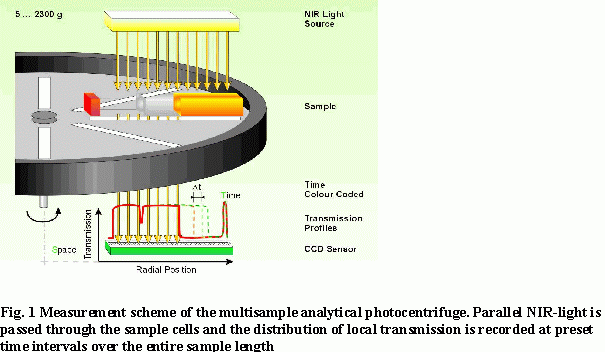
The multisample analytical centrifuge - LUMiFuge® (L.U.M. GmbH Germany) used in this study employs the STEP technology, which allows to measure the intensity of the transmitted light as function of time and position over the entire sample length simultaneously (Measurement scheme see Fig. 1).


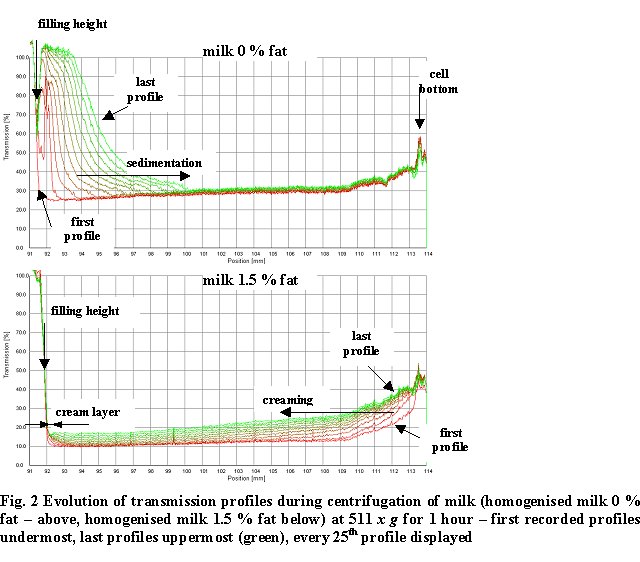
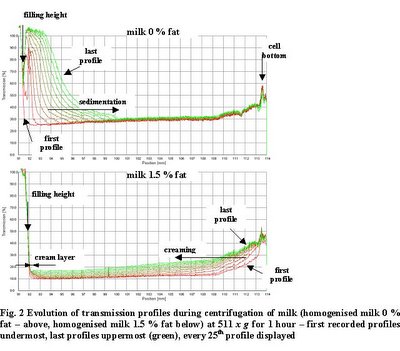
The data are displayed as function of the radial position, as distance from the centre of the rotation (transmission profiles, see Fig. 2). The progression of the transmission profiles contains the information on the kinetics of the destabilization processes (creaming, sedimentation, coalescence, phase separation) [1-2]. At the same time up to 12 different samples can be analysed at constant or variable centrifugal speed up to 2300 x g. The separation behaviour of the individual samples can be compared and analysed in detail by tracing the variation in transmission at any part of the sample or by tracing the movement of any phase boundary.

Sample pretreatment

Samples were used as received or after a freeze-thaw cycle as an accelerated aging test.

RESULTS AND DISCUSSION

The overall separation behaviour measured can vary very much between different samples depending on composition and destabilizing processes. Whereas a skimmed milk sample exhibits a typical sedimentation behaviour of the casein particles, homogenised milk with a reduced fat content shows typical creaming behaviour (Fig. 2). The transmission profiles are moving towards the bottom of the cell indicating the sedimentation of particles or in the opposite direction when creaming occurs. In the second case a thin cream layer evolved on top of the sample marked by a reduction in transmission.


Comparison of the separation stability for different formulations is a frequent task. As an example the creaming behaviour of cream liqueur samples of different composition is compared (Fig. 3). The creaming kinetics can be analysed by tracing the movement of the phase boundary cream – separated continuous phase (sugar solution). The position of this boundary is denoted as distance from the centre of rotation.
The initial creaming rate is given by the slope at the start of centrifugation, the equilibrium height of the separated continuous phase as difference between the position of the cell bottom (113.8 mm) and the position of the phase boundary at equilibrium. Experiments were repeated at several other centrifugal accelerations to check whether the order of stability depends on this parameter (Tab.1). As the order of stability is (3) > (1) > (2) independent of the centrifugal acceleration
results should be valid at normal gravity too.


Table 1. Initial creaming velocity for cream liqueur samples 1 to 3, determined for centrifugation at 128, 287 and 1100 x g

sample

velocity at 128 x g [µm/s]

velocity at 287 x g [µm/s]

velocity at 1100 x g [µm/s]

(1)

2,0

4,2

15,5

(2)

3,5

7,4

33,0

(3)

1,1

2,2

9,9

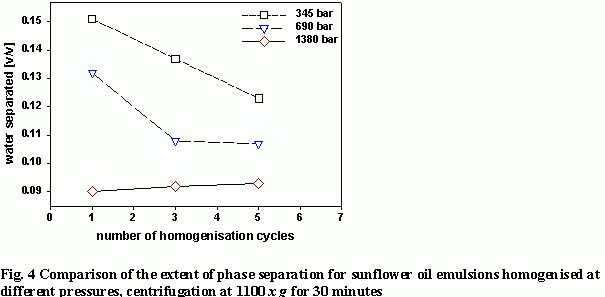
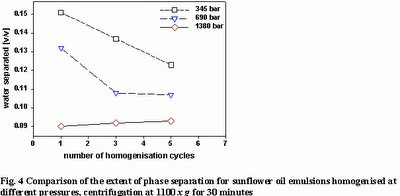
Selection of processing conditions for the manufacturing process is a key for economic production of stable products. Fig. 4 gives an example for the preparation of sunflower oil emulsions with the Microfluidizer® technology varying the homogenisation pressure and number of processing cycles. As obvious from Fig. 4 homogenisation efficiency is highest at the highest pressure, repeated homogenisation is only useful at lower homogenisation pressures.


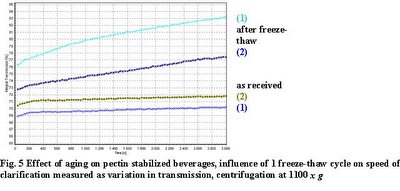
Evaluation of long term stability is often complicated by slow diffusion based destabilization processes, which cannot be foreseen by analytical centrifugation. However, the result of these processes can be traced far more faster then by naked eye. An example is given in Fig. 5 for pectin stabilized beverage samples. In this case the stability was measured by the variation of turbidity during centrifugation. As can be seen the fresh samples exhibited a similar behaviour. However, they were markedly destabilized after only one freeze-thaw cycle. After this, sample (1) showed a substantial higher loss of stability. The same trends were observed after 6 week of storage but less pronounced.


Acknowledgement

We thank for the support of the Bundesministerium für Wirtschaft und Technologie (grant number KA 0047301AWZ3).

REFERENCES

[1] T. Sobisch, D. Lerche, SCI/RSC/SCS Conference Cosmetics and Colloids, London 15 February 2005
http://www.soci.org/SCI/groups/col/2005/reports/pdf/gs3257_sob.pdf

[2] T. Sobisch, D. Lerche, Chemistry Preprint Archive, Volume 2004, Issue 5, May 2004, Pages 7-18

http://www.sciencedirect.com/preprintarchive